Tehanld lists noise output as an explicit spec — 36 dB on the beverage fridges, 38 dB on the mini fridge line — because buyers placing a fridge in a bedroom or next to a desk deserve a real number, not a marketing adjective.
The 3.6 cu.ft double-door models draw 0.48 kWh per day, and the 3.2 cu.ft beverage fridges carry ETL certification — verifiable performance benchmarks, not rounding-friendly approximations.
Every Tehanld order comes with a documented 12-hour customer response commitment; if something goes wrong, a prepaid return label is provided — no haggling over who covers shipping.
Warranty terms scale with the product: 1-year full coverage on beverage fridges, a 1-year full plus 2-year compressor warranty on the 3.6 cu.ft hero models, and 3-year coverage on the 4.5 cu.ft mini fridge flagship pair.
Tehanld's beverage refrigerators, mini fridges with freezer, and water cooler dispenser each solve a different problem — but all three are built for the same buyer: someone furnishing a space where a full-size appliance either won't fit or doesn't make sense. The lines complement each other; a dorm setup that needs a drink fridge and a water dispenser, for instance, can run both from the same small footprint.
Glass-door beverage fridges from 0.6 cu.ft countertop units to 3.2 cu.ft floor-standing models, all running at less than 36 dB — built for offices, home bars, and bedrooms where a drinks-only fridge makes more sense than a full kitchen unit.
Double-door mini fridges with a genuinely independent top freezer — the 3.6 cu.ft models hold -0.4°F in the freezer zone regardless of what the fridge door is doing, which is a different thing entirely from the alcove "freezer" on single-door units.
Tehanld's bottom-loading water dispenser eliminates the single worst part of owning a water cooler — hoisting a 42-lb jug overhead — while delivering cold water below 45°F and hot water at 185–203°F from a stainless steel unit that doesn't look out of place in a living room. ```
These 12 cover the range from a 21-lb countertop cooler to the 4.5 cu.ft flagship mini fridge — the ones that keep selling because the specs match specific situations rather than because they're the cheapest option in the category.
The beverage fridge line runs from a 0.6 cu.ft countertop unit (14.88" deep, 21.6 lbs) up to 3.2 cu.ft floor-standing models that hold 128 cans or 26 standard wine bottles. Every unit in the line uses compressor cooling — not thermoelectric — which means stable temperatures even when the room gets warm, and a digital control panel with a 35–65°F range that covers everything from lager serving temp to red wine. The 1.8 cu.ft gaming fridge is the line's specialty option, built desk-height at 19.65" tall with an RGB-illuminated glass door.
The Tehanld beverage fridge line runs from 35–65°F across all models — a range wide enough to cover everything from a tightly chilled lager to a fully rested Bordeaux. But "adjustable" doesn't help much if you don't know where to set it. Here's what the science actually says about serving temperatures, matched against what the Tehanld controls can deliver.
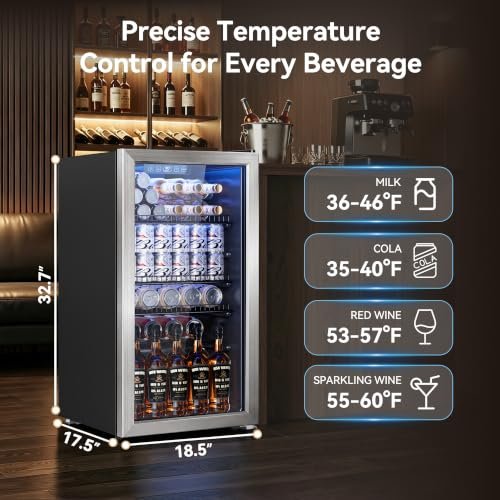
Most lagers, pilsners, and light beers drink best between 38–42°F. IPAs and pale ales typically show more flavor complexity around 44–48°F — cold enough to be refreshing, warm enough for the hops to register. Soda and sparkling water are almost always better at the colder end: 35–40°F. All Tehanld beverage fridges hit these targets. Set the digital display toward the lower end of the range (36–40°F) for cans and standard American-style beers. If you're storing craft ales, bump it to 44–46°F.
White wines and rosé serve best at 45–52°F — cold enough to feel crisp, not so cold that the aromatics go flat. Light-bodied reds like Pinot Noir are best around 55–60°F. Full-bodied reds — Cabernet, Syrah, Malbec — are typically served at 60–65°F, which is the upper limit of the Tehanld beverage line. The 3.2 cu.ft models hold up to 26 standard bottles; the 2.5 cu.ft models hold up to 22. If you're running a mixed white/red collection, white wine at 48°F and light red at 58°F are both achievable in the same unit — you'd just be setting the temperature to a middle ground, which is a reasonable compromise for most home setups.
One model worth calling out specifically for wine storage is the 3.1 cu.ft unit (B0GSZP876Z). Its 4 adjustable chrome shelves plus 8 door slots give you more interior layout flexibility than any other Tehanld beverage fridge, which matters when you're storing a mix of bottle sizes and can orientations. Its temperature range is listed as 34–64°F — slightly extended on the cold end compared to the rest of the line.
One thing worth being clear about: all Tehanld beverage fridges use a single-zone temperature system. You set one temperature for the whole interior. There's no dual-zone wine fridge functionality here — no separate reds-at-60°F and whites-at-48°F in the same unit. If that's what you need, you're looking at a different product category entirely. For single-temperature beverage storage, these units do the job well.
Five models with genuinely different dimensions, capacities, and features. The right one depends less on how much you want to spend and more on where the fridge is going and what you're putting in it. Here's how to think through the decision without getting lost in overlapping specs.
Two models work here. The 0.6 cu.ft countertop cooler (B0H1LY5LX9) is 16.73" tall and 11.02" wide — it fits on a desk beside a monitor, on a kitchen counter without blocking upper cabinets, or on a side table. At 21.6 lbs, it's light enough to relocate without help. The tradeoff: 0.6 cu.ft holds roughly 18 liters of drinks. That's a 12-pack of cans plus a few extras, not a weekly supply. Manual defrost is the other tradeoff, though at this size that's a 15-minute task every few weeks.
The 1.8 cu.ft gaming fridge (B0GL8CBMXN) is 19.65" tall — just under desk height, which is the point. It holds up to 68 standard 12-oz cans when tightly packed, and the RGB-illuminated glass door lights up the interior in a way that makes it part of the room's aesthetic rather than an appliance you're trying to hide. Left-hinge door is important to note: plan the placement so the door swings into open space, not into a wall or desk leg. This model is also the only one in the line built from aluminum door material with a metallic finish — it's noticeably more solid-feeling than the plastic-door 0.6 cu.ft unit.
The two 2.5 cu.ft models (B0GYS667DV in black, B0GYS8F7VZ in silver) stand 26.6" tall — shorter than the 3.2 cu.ft units, same 17.5" width and 18.5" depth. This is the right size if you want a floor-standing fridge that doesn't dominate a small bedroom or office corner. Both hold up to 22 bottles or 95 cans and come with three removable wire shelves for flexible interior layout. Frost-free defrost means you don't deal with ice buildup. At 50.72 lbs, they're heavier than they look — position them before loading.
The 3.2 cu.ft models (B0D2WDFR6C in silver, B0D1FQP15K in black) stand 32.7" tall with the same 17.5" × 18.5" footprint as the 2.5 cu.ft versions. Both hold up to 26 wine bottles or 128 cans, with three removable wire shelves and a key lock — useful in a shared office or entertainment space where you'd rather not have the whole room raiding your collection.
The black model (B0D1FQP15K) uses R-290 refrigerant and draws 181 kWh/year. The silver model (B0D2WDFR6C) draws 288 kWh/year. Same capacity, same dimensions, meaningfully different energy draw. If long-term running cost matters, the black is the better choice. Both are ETL certified and run at under 36 dB.
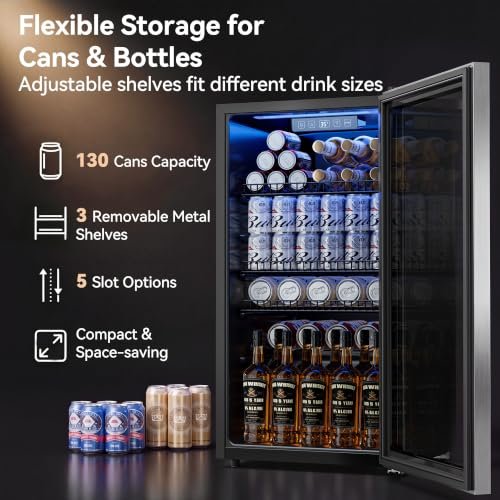
The 3.1 cu.ft model (B0GSZP876Z) stands 31" tall, slightly shorter than the 3.2s, but it's the only unit in the Tehanld beverage line with 4 adjustable chrome shelves plus 8 tiered door slots. That door storage is genuinely useful — it's where standard cans fit perfectly upright, leaving the main shelves free for bottles. The reversible door is also unique to this model: you can configure the hinge to swing left or right depending on your placement. If you're fitting the fridge into a corner where the standard right-hinge door would swing into a wall, this is the only Tehanld beverage fridge that solves that problem.
None of these beverage fridges are right if you need to store food — raw ingredients, leftovers, dairy, anything that needs to stay below 40°F for food safety alongside frozen items. The beverage line is drinks-only by design. The glass doors and display lighting are features built around showing off a collection, not around food storage efficiency. If that's your use case, the mini fridge with freezer line is where to look.
Tehanld's mini fridge line splits into two size clusters: the 3.5–3.6 cu.ft double-door models for tighter spaces and the 4.4–4.5 cu.ft models for buyers who need maximum compact capacity. All of them use a two-door design where the top freezer is physically separated from the fridge zone — not an alcove inside the same cavity. The 3.6 cu.ft hero models (rated 4.5 stars across 138 reviews) hold the freezer at -0.4°F independently, draw 0.48 kWh per day, and operate at 36 dB. The 4.5 cu.ft flagship pair carries a 3-year warranty and adds rear wheels for repositioning.
The honest answer: yes — but only on the double-door models, and only because the freezer compartment is physically separate from the fridge zone. That distinction matters more than most listings make clear, and it's worth understanding before you buy.
Most single-door mini fridges include a small metal-lined alcove near the top of the main cavity that's called a "freezer section" in listings. That alcove doesn't have its own insulation, its own door, or its own temperature control. When you open the main fridge door, warm air floods the alcove. In practice, these sections hover around 15–20°F at best — cold enough to make ice cubes, sometimes cold enough to keep ice cream from melting, but not reliably cold enough for raw meat storage or anything you'd want to keep frozen for more than a few days. They're also the first thing that warms up when the ambient temperature in the room rises.
The Tehanld double-door models work differently. The 3.6 cu.ft models (B0GTYTGFCN in black and B0H4JJ1419 in silver) have a physically separate top freezer compartment behind its own insulated door. That compartment holds a steady -0.4°F independently of what's happening in the fridge zone below. Opening the fridge door to grab a drink doesn't warm the freezer. The fridge zone runs 32–50°F on a 7-level mechanical thermostat; the freezer temperature is fixed at -0.4°F regardless of where the thermostat is set.
The 3.5 cu.ft model (B0F64TPNC9) follows the same dual-door design with a 1.0 cu.ft freezer compartment and 2.5 cu.ft fridge zone. The 4.5 cu.ft models (B0D95LVQNG and B0DB1FSNJ3) scale this up to a 1.2 cu.ft freezer and 3.3 cu.ft fridge zone at 42.5" tall — the largest capacity in the line.
At -0.4°F, the Tehanld freezer compartment sits well below the 0°F mark that the USDA identifies as safe long-term frozen storage temperature. Ice cream stays solidly frozen at this temperature — not softened or semi-frozen, but actually hard. Chicken breasts, ground beef, and fish filets stored properly wrapped will hold for weeks without texture or flavor degradation. Ice cubes form fully and don't partially melt during formation. This is a real freezer, not a cold shelf.
The mechanical thermostat on the 3.6 cu.ft models uses a 7-level dial, not a digital degree display. Level 4 is the recommended starting point for daily use. You're setting a cooling intensity, not a precise °F target. In practice this works fine — the fridge zone stays in the 32–50°F range across normal settings — but buyers who want to dial in exactly 37°F should know that's not how these thermostats work. Set it at 4, let it run for a few hours, check with a thermometer if you want to verify, and adjust from there.
Leave the fridge upright and unplugged for at least 6 hours after delivery — the Tehanld listing recommends 6 hours specifically. Shipping can jostle the refrigerant out of the compressor, and plugging in immediately before it's had time to settle is the most common cause of "my fridge isn't getting cold" complaints in the first 24 hours. This isn't a defect. It's physics. Wait the 6 hours. The freezer should reach -0.4°F within a few hours of startup after that rest period.
Be direct about this: if you need serious frozen food capacity — a month's worth of meal prep, large cuts of meat, a full deep-freeze reserve — a 1.0 cu.ft freezer compartment isn't going to do it. At 1.0 cu.ft, you're looking at space for a few frozen meals, a tray of ice, and maybe a pound of chicken. The 4.5 cu.ft model's 1.2 cu.ft freezer is only marginally larger. These are genuine compact freezers for daily needs in a small space, not substitutes for a standalone chest freezer. If you need deep-freeze volume, this line isn't it.
Tehanld makes three distinct product lines — beverage fridges, mini fridges with a real freezer compartment, and a bottom-loading water dispenser — and they're built for genuinely different needs. Getting the right one comes down to a single question: what are you actually trying to store?
Choose a beverage refrigerator if your storage is drinks-only. The Tehanld beverage line runs from 0.6 cu.ft on a countertop to 3.2 cu.ft floor-standing, all operating between 35–65°F. That range covers lager at 38°F through red wine at 65°F, but it's deliberately beverage territory — not a food-safe zone for raw meat or dairy. The glass door and interior LED light are features that make sense when you're displaying a collection. They're a waste of money when you just need cold leftovers. If your only goal is cold drinks, this is the right line and you don't need to look further.
Choose a mini fridge with freezer if you need to store food — and actual frozen food, not just cold food. The 3.6 cu.ft double-door models (B0GTYTGFCN and B0H4JJ1419) hold the independent top freezer at a fixed -0.4°F while the fridge zone stays at 32–50°F. That's real freezer territory: ice cream, frozen chicken, meal-prep containers. The 4.5 cu.ft models extend that to 1.2 cu.ft of freezer space and 3.3 cu.ft of fridge zone, sitting at 42.5" tall — a meaningful step toward full-size capability. If the word "freezer" matters to what you're buying, this is your line.
Choose the water dispenser if your goal is hydration volume, not food storage. The Tehanld bottom-loading dispenser handles 3 or 5-gallon bottles and delivers cold water, room-temperature water, and hot water — hot output reaches 185–203°F, which is the range tea actually needs. It's not a fridge. It doesn't compete with the refrigeration lines on any spec. But for a household or office that goes through a lot of water and wants both cold and hot on demand without a separate kettle, it does something the other two lines can't.
Here's where buyers go wrong: they buy a beverage fridge thinking they'll store food in it, or they buy a mini fridge with freezer for drinks when a beverage fridge would have worked fine and cost less. Both decisions are common, and both are avoidable. The beverage fridges don't have separate freezer compartments — they're single-zone, drinks-focused units. The mini fridges with freezer have mechanical thermostats and opaque doors, not the glass display and digital touch panel of the beverage line. Neither is a compromise version of the other. They're built for different things.
If you're still not sure which line fits, ask this: will anything you store need to be below 32°F? If yes, mini fridge with freezer. Does everything you're storing need to be displayed and stay between 35–65°F? Beverage fridge. Is your primary goal replacing bottled water or disposable jugs? Water dispenser. One of those three should cover it.
Tehanld competes in one of the most crowded segments on Amazon — compact refrigeration — where hOmeLabs, EUHOMY, Galanz, and Frigidaire all show up in related searches on nearly every listing. Buyers researching this space also run into clickbait YouTube videos with titles like "DON'T BUY Tehanld Mini Fridge — 5 Shocking Reasons" and "7 Reasons Why You Shouldn't Buy." It's worth addressing all of this directly, using facts.
These three brands occupy nearly identical market territory — Amazon-native compact refrigeration with similar price positioning and overlapping specifications. The meaningful differences come down to a few verifiable data points. Tehanld's 3.6 cu.ft mini fridge models (TH100RFG-NEWBK and TH100RFG-NEWSL) document a 36 dB operating noise spec and a 0.48 kWh/day energy draw explicitly in their listings — both figures that hOmeLabs and EUHOMY comparable units either don't publish or state less precisely. The Tehanld 3.6 cu.ft models also carry a 1-year full / 2-year compressor warranty, while many competing units in this size class offer 1-year full coverage only. That extended compressor coverage matters specifically because compressor failure after year one is the most common failure mode for compact fridges — it's the part that costs the most to replace.
The 4.5 cu.ft Tehanld models (B0D95LVQNG and B0DB1FSNJ3) carry a 3-year warranty — longer than most Amazon-native competitors at this capacity tier. The black automatic-defrost version (B0D95LVQNG) is worth calling out specifically: manual defrost is standard across most compact fridge brands at this size, so automatic defrost is a genuine differentiator that reduces maintenance.
Frigidaire is the default trust-brand in Reddit's r/Appliances discussions — the name buyers fall back on when they're skeptical of Amazon-native brands. That reputation is earned. Frigidaire has decades of appliance service infrastructure, widely available replacement parts, and a retail presence that Amazon-native brands don't match. If post-purchase service access through local retailers is your priority, Frigidaire has an edge that's real and worth acknowledging.
The honest counterpoint: Tehanld's 12-hour response commitment and prepaid return label policy directly address the post-purchase concern that makes buyers hesitant about smaller brands. You don't have to find a service center — you contact support through your Amazon order and get a return label sent to you. Whether that's equivalent to Frigidaire's service network depends on your situation, but for buyers in dorms, apartments, or home offices who would be shipping a unit for service anyway, the practical difference narrows considerably.
In the water dispenser category, Avalon's A4 and Brio's 500 Series appear on essentially every "best water cooler" editorial list — BobVila, The Spruce, Food & Wine all feature them. Both carry Energy Star certification, which Tehanld's dispenser doesn't appear to match based on available listing data. If Energy Star certification is a specific requirement, Avalon and Brio are the more documented choices.
The area where the Tehanld bottom-loading dispenser holds its own is aluminum alloy construction — most dispensers in this price range use plastic housings. Aluminum alloy is heavier and doesn't flex the same way. Whether that matters to you is a legitimate preference question, not a marketing claim. The built-in night light and LED empty-bottle alert are functional touches that several competing models at similar prices don't include. And the bottom-loading design itself eliminates the 42-lb overhead-jug problem that makes top-loading dispensers genuinely difficult for buyers who refill frequently or live alone.
The "Don't Buy" and "7 Reasons to Avoid" videos targeting the Tehanld mini fridge line are real, and buyers find them. What they aren't is documented product failure data. This format — clickbait-titled critique videos for Amazon products — is a known genre of engagement-driven content that generates watch time regardless of whether the underlying concerns are brand-specific or category-wide. The concerns those videos raise are legitimate category concerns: "will it actually cool?", "is the noise level real?", "what happens if it breaks?" Those questions deserve real answers.
So: the 3.6 cu.ft double-door models run at 36–38 dB, measured and listed in the spec. The 0.48 kWh/day energy draw is documented. The 12-hour response commitment and prepaid return label are stated in the product FAQ. The most common reason a new mini fridge "doesn't cool" in the first 24 hours is plugging it in immediately after delivery before the refrigerant has stabilized — leave it upright and unplugged for at least 6 hours after arrival, 12 if you can, and that issue disappears. That's not a Tehanld problem; it's a compressor-refrigerant physics issue that applies to every brand in this category.
We flagged this roundup because it cuts through the noise of a crowded category and puts several compact fridges head-to-head on the things that actually matter — cooling performance, footprint, and whether the freezer compartment does real work. You'll see how the field stacks up and where Tehanld lands against units at similar sizes. It's a useful gut-check before you commit to any model, including ours.
"I picked up the 1.8 cu.ft RGB Gaming Fridge for my desk setup and honestly it looks way better in person than in the photos. The lighting is genuinely cool, not cheap-looking. Holds 68 cans tightly packed just like the listing says. The compressor does cycle on and off, which you'll hear if the room is dead silent at 2 a.m., but during normal use at 38 dB it disappears into background noise. Not a kitchen replacement — but that was never the point."— Marcus T., Home office and gaming setup buyer, on Beverage Refrigerator
"I needed a compact beverage fridge for my home bar corner and the 3.2 cu.ft Black model fits exactly where I needed it. The glossy black glass door looks clean, and the key lock is a nice touch when you have people over. One thing to know: peel off the protective film on the glass before you plug it in — I missed that the first day and wondered why the door looked hazy. After that, no complaints."— Denise K., Space-constrained renter furnishing a studio apartment, on Beverage Refrigerator
"Bought the 3.6 cu.ft Double Door Mini Fridge in black for my bedroom. The freezer actually freezes — I've had single-door units before where the 'freezer' was just a cold shelf that turned ice cream to soup. This one holds a real -0.4°F and the fridge zone sits around 37°F on setting 4. At 0.48 kWh per day it's not adding anything noticeable to the electric bill. Left it unplugged for 6 hours before first use like the manual says and it cooled down without any issues."— James R., Dorm-bound student (sophomore year apartment), on Mini Fridge with Freezer
"My partner and I have a small apartment with a shared kitchen fridge that's always full. The 4.5 cu.ft model in silver gave us back 3.3 cu.ft of fridge space and 1.2 cu.ft of actual freezer — enough for a week of frozen meals. The wheels make it easy to pull out from the wall for cleaning. It's manual defrost, which means you do have to handle frost buildup every couple of months. Not a dealbreaker, just something to know going in."— Aisha M., Space-constrained renter with a shared kitchen, on Mini Fridge with Freezer
"We've had the 3.6 cu.ft silver mini fridge in our home office for about four months. My main concern before buying was noise — I'm on video calls most of the day and didn't want hum in the background. It's genuinely quiet. I've never had it picked up on a call. The heat compensation button was new to me; turns out it matters in winter when the room gets cold and the compressor slows down. Useful detail that the manual actually explains."— Priya L., Work-from-home buyer with noise sensitivity, on Mini Fridge with Freezer
"We switched from a top-loading water cooler to the Tehanld bottom-loading dispenser and the difference is significant. Sliding a full 5-gallon jug into the bottom cabinet instead of hoisting it overhead was the main reason we bought this — my wife has a bad shoulder and the old setup was a problem every week. The LED alert tells you when you're almost out so there's no guessing. Hot water output is genuinely hot, plenty warm enough for tea. The unit makes some noise during the heating cycle, noticeable in a quiet room at night, so we keep it in the kitchen."— Doug F., Household water dispenser upgrader with young kids at home, on Water Cooler Dispenser
Tehanld beverage fridges cool down to 35°F at the lowest digital setting — which is colder than most kitchen fridges run in practice. The 35–65°F range covers everything from cold soda storage to red wine. These units are optimized for beverages, not food preservation, so they don't have a freezer compartment.
The most common issues across the category are uneven cooling (usually from blocked vents), condensation on the door from frequent opening, and frost buildup on manual-defrost models. Tehanld's frost-free models — including the 3.2 cu.ft and 2.5 cu.ft beverage fridges — eliminate the frost issue. For condensation, the low-E glass door coating helps reduce it noticeably.
Compressor-based beverage fridges typically last 8–12 years with proper maintenance — significantly longer than thermoelectric models. Tehanld's beverage fridges use compressor cooling. The single most common cause of early failure in any brand is plugging in immediately after delivery without allowing refrigerant to settle; the listing specifies 6–12 hours of rest before first use.
The 3.1 cu.ft 130-Can Beverage Fridge (Model 1089) holds up to 130 standard cans across its 4 adjustable chrome shelves and 8 door slots. That's the most interior flexibility in the Tehanld beverage line — no other model includes door slots, which let you store shorter cans without wasting shelf space.
Yes, with one caveat about size. The 3.6 cu.ft Double Door Mini Fridge runs at 36–38 dB and draws 0.48 kWh per day — both figures that matter in shared housing. The independent top freezer holds -0.4°F, which is real freezer territory. The footprint is 19.31" wide × 17.71" deep, which fits under most standard dorm desks.
The 3.6 cu.ft double-door models draw 0.48 kWh per day — roughly 175 kWh per year. At the US average residential electricity rate, that's well under $30 annually to run. The 4.5 cu.ft models are listed at 288 kWh per year, which is still modest compared to full-size refrigerators that typically use 400–600 kWh annually.
The physical separation is what matters. Tehanld's double-door models — the 3.5 cu.ft and 3.6 cu.ft — have an insulated top freezer compartment behind its own door, holding a fixed -0.4°F. Single-door units have a small alcove inside the main cavity that fluctuates whenever you open the door. The double-door design keeps the freezer temperature stable regardless of how often you access the fridge zone.
Compact refrigerators with compressor cooling — like all Tehanld mini fridge models — typically last 8–10 years under normal use. Tehanld backs the 3.6 cu.ft models with a 1-year full warranty plus a 2-year compressor warranty; the 4.5 cu.ft models carry a 3-year warranty. Following the 6-hour pre-use resting period after delivery prevents the most common early failure mode across the category.
Tehanld currently offers one water cooler model — the Bottom Loading Water Cooler Dispenser (TH0737MS) in metallic silver — rated 4.2 out of 5 stars from 175 reviews on Amazon. It supports 3 or 5-gallon bottles, dispenses hot, room-temperature, and cold water, and includes a child safety lock on the hot spout and an LED empty-bottle alert.
For most households, yes — practically speaking. A full 5-gallon water jug weighs approximately 42 lbs. Top-loading dispensers require you to hoist that jug overhead and invert it into the opening. The Tehanld bottom-loading dispenser lets you slide the jug in at floor level; an internal pump draws water up. The main trade-off is pump reliance — if the pump fails, a top-loader keeps working by gravity.
Tehanld commits to a 12-hour response time on support requests through Amazon's "Your Orders" page. If a return is approved, they provide a prepaid return label — buyers are not responsible for return shipping costs. Warranty terms vary by product: 1-year full coverage on most beverage fridges, 1-year full plus 2-year compressor on the 3.6 cu.ft mini fridge models, and 3-year coverage on the 4.5 cu.ft models.
Tehanld started with a simple observation: the spaces where a lot of people actually live — dorm rooms, studio apartments, home offices, bedrooms — get treated as afterthoughts by appliance manufacturers. Full-size refrigerators assume a full-size kitchen. Water dispensers assume someone strong enough to hoist a 42-lb jug over their head every week. The compact appliance category, meanwhile, filled up with vague specs and adjectives no one could verify. Tehanld's answer was to build products sized and specced for smaller spaces, and to publish the numbers that buyers need to actually evaluate them — not just say "quiet" and call it done.
The mini fridge with freezer line came first, centered on the problem that nearly every cheap compact fridge misrepresents. A "freezer compartment" in a single-door unit is almost never a real freezer — it's an alcove that swings between temperatures every time the door opens. Tehanld's double-door design, most visible in the 3.6 cu.ft models (rated 4.5 stars across 138 reviews), puts the freezer behind its own insulated door holding a fixed -0.4°F. The fridge zone runs independently at 32–50°F. That's the physical distinction the category kept glossing over. The beverage refrigerator line addresses a different problem: buyers who want drinks cold and accessible — at a desk, in a game room, behind a home bar — don't need a freezer compartment. They need precise temperature control across a wider range (35–65°F covers lager temperature at the low end and red wine at the high end), a glass door that lets them see what's inside without opening it, and an operating noise level low enough that it doesn't compete with a microphone or a sleeping roommate. The gaming fridge — 1.8 cu.ft with an RGB-illuminated glass door — takes that logic one step further for buyers who want the unit to be part of the room's aesthetic, not hidden in a corner.
The water cooler dispenser line grew from the same reasoning. If you're replacing disposable bottles or a top-loading cooler, the act of swapping a 5-gallon jug shouldn't be a physical challenge. The Tehanld bottom-loading dispenser (TH0737MS) handles 3 and 5-gallon bottles from a base cabinet, eliminates the overhead lift entirely, and adds a child safety lock on the hot spout and an LED empty-bottle alert so you're never caught dry. Across all three lines — mini fridges with freezer, beverage refrigerators, and the water cooler dispenser — the common thread is engineering that matches what the space actually requires, not a full-size kitchen standard scaled down and relabeled compact.
Here's the sentence: We've put together straightforward guides on the questions that come up most often—sizing, noise levels, maintenance, and how to actually choose between models.
Tehanld makes compact cooling appliances for smaller living spaces — mini fridges with freezer, beverage refrigerators, and bottom-loading water cooler dispensers. All three product lines are sold through the Tehanld Store on Amazon. ETL certification applies across most models in the beverage and mini fridge lines.
For any issue with a Tehanld product, contact the brand through your Amazon account: go to "Your Orders," locate the order ID, and click "Contact Seller." Tehanld commits to responding within 12 hours. This support process applies to all three product lines.
Warranty terms vary by product: most beverage fridges carry a 1-year warranty; the 3.6 cu.ft double-door mini fridges include a 1-year full warranty plus a 2-year compressor warranty; the 4.5 cu.ft mini fridge models are covered for 3 years. If a return is approved, Tehanld provides a prepaid return label — buyers are not responsible for return shipping costs.